

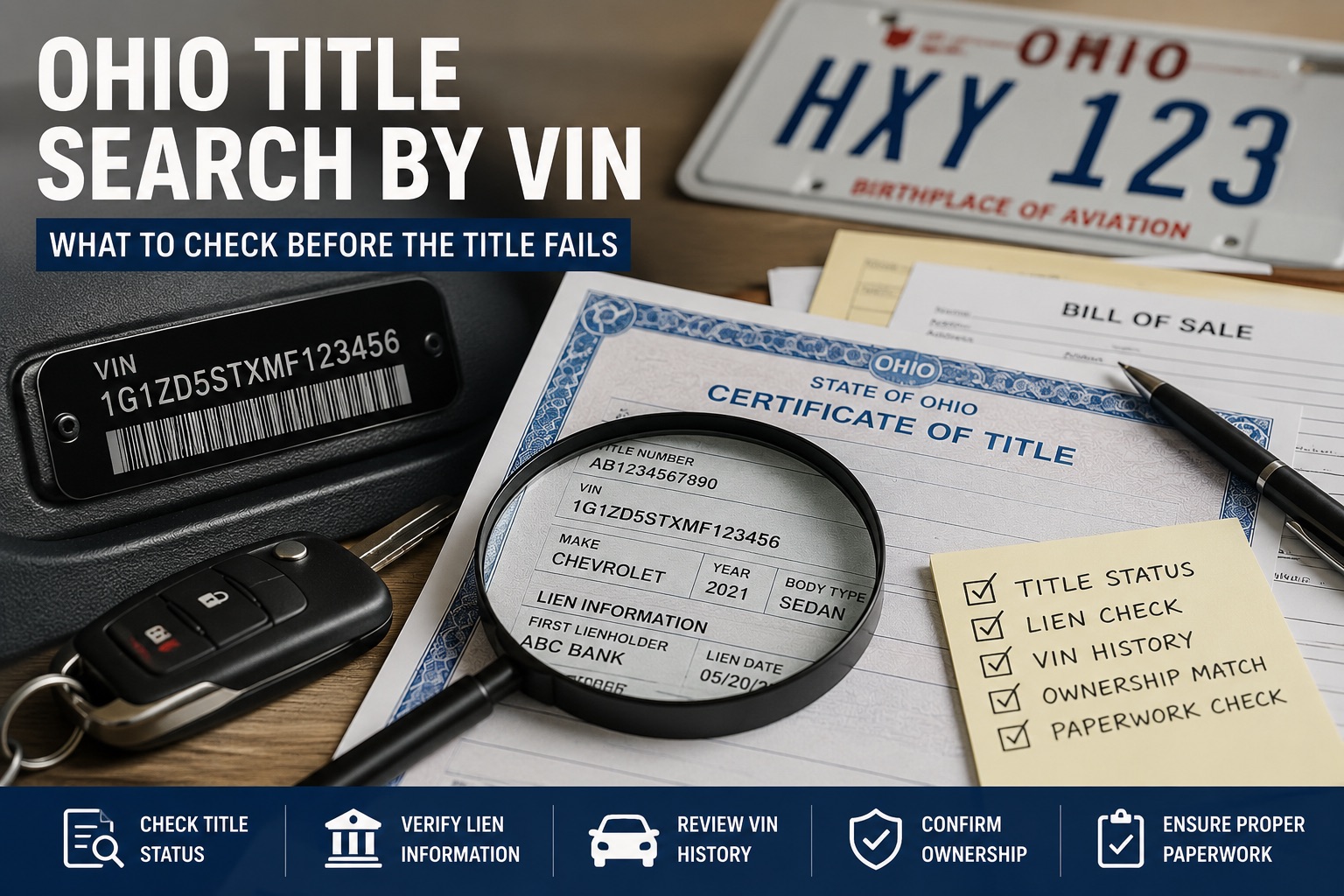
The VIN report looked clean.
No major accident warning. No obvious salvage flag. Nothing that made the buyer nervous.
Then the title process stopped because the lien was still showing, the seller was not properly tied to the title, or the paperwork did not match what Ohio needed to issue a clean transfer.
That is the part most people miss.
An Ohio title search by VIN is not just about finding a vehicle history report. It is about checking whether the vehicle can actually move through Ohio’s title system without a lien, ownership, brand, or paperwork problem stopping the transfer.
For the broader title status process, start with our Ohio Title Search guide.
A Clean VIN Report Does Not Mean the Ohio Title Is Clean
A VIN report can be useful. It can show accident history, title brands, odometer events, theft records, auction history, and other vehicle history signals.
But it does not control the Ohio title record.
It does not issue a title.
It does not release a lien.
It does not prove the seller has legal authority to transfer the vehicle.
It does not fix a title that was signed wrong.
It does not override what the County Clerk of Courts title office sees when the title is processed.
That is why the VIN matters, but the source matters more.
If you are buying, selling, or transferring a vehicle in Ohio, the goal is not just to ask, “Does the VIN look clean?”
The better question is:
“Does the VIN, the Ohio title record, the lien status, and the actual paperwork all line up?”
What an Ohio Title Search by VIN Actually Checks
An Ohio title search by VIN uses the vehicle identification number to review title-related records connected to that vehicle.
Depending on the source being used, a VIN can help check:
Title status
Title number
Lien information
Vehicle brands such as salvage, rebuilt, flood, or junk
Out-of-state title history
Odometer or theft records
Potential ownership or transfer problems
The mistake is thinking all VIN searches are equal.
A consumer VIN report and an official Ohio title record are not the same thing. A VIN history tool may help identify risk. Ohio title records help determine whether the vehicle can be titled, transferred, or corrected through the Ohio title process.
The Ohio Title Search Triple Check
Before money changes hands, use the VIN to run three separate checks.
This is the simplest way to avoid confusing a clean-looking vehicle with a clean-transferable title.
Check the Ohio Title Record
Start with the official Ohio title record tied to the VIN or title number.
This helps answer:
Does Ohio have a title record for this vehicle?
Does the VIN match the title paperwork?
Is the title number consistent?
Is there an active lien showing?
Is the record consistent with what the seller is telling you?
This matters because Ohio title and lien records are not the same as a generic vehicle history report. Ohio vehicle titles are issued through County Clerk of Courts title offices, while statewide title and lien records are maintained through the Ohio title system.
That split matters when something is wrong.
The BMV may provide online title and record tools. The County Clerk of Courts title office is where many title corrections, issuances, and transfer problems are actually handled.
If the seller says everything is clean but the Ohio record says otherwise, stop there.
Do not negotiate around a title problem you do not understand.
Check the Lien Status
A lien is one of the easiest title problems to underestimate.
The seller may say the loan was paid.
The lender may say the account is closed.
The VIN report may not make the problem obvious.
But if the lien is still reflected in the title record, the vehicle may not be ready for clean transfer.
This is especially common around payoff situations.
The loan payoff is one step.
The lien release is another step.
Getting a clean title after the release may be another step.
If the vehicle had an electronic title or an electronic lien, the owner may need to make sure the release was recorded and that the title is in the right form for the next transaction.
If this is the issue, read Payoff Title Ohio or How to Remove a Lien from a Title in Ohio.
Check the VIN History for Red Flags
After checking Ohio title and lien status, a VIN history report still has value.
Use it as a second layer.
A VIN history report may show:
Prior salvage or rebuilt branding
Flood or junk history
Odometer inconsistencies
Theft records
Accident history
Auction records
Out-of-state title events
Prior lien activity
This helps because Ohio title records may not tell the whole story of the vehicle’s history across multiple states, insurers, auctions, or prior owners.
But the order matters.
Do not use the VIN report as the final answer.
Use it as a warning system.
Where Ohio Title Searches Go Wrong
The problem is usually not that someone skipped the VIN search completely.
The problem is that they checked one source, trusted it too much, and missed the part that actually controls the transfer.
The Seller Paid Off the Loan, But the Title Is Not Clear
This is a common payoff failure pattern.
The seller thinks the car is ready to sell because the loan balance is gone. But the title still has to show that the lien was released properly.
A paid-off loan does not automatically mean the title in hand is clean, current, and ready to sign over.
Before buying the vehicle, confirm:
The lien was released
The title record reflects the release
The seller has the correct title document
The lienholder information on the title does not conflict with the state record
If any of those are unclear, the title path is not clear yet.
The Seller Is Not the Name on the Title
This is where a lot of private-party deals fall apart.
The person with the keys is not always the person with legal authority to transfer the vehicle.
Be careful with lines like:
“My brother never transferred it.”
“My cousin signed it already.”
“The title is open.”
“The name does not matter.”
“We can just write it in.”
It does matter.
If the seller’s name does not line up with the title, identification, signatures, and ownership chain, the title office may not be able to complete the transfer.
If the vehicle title is not in your name or the seller’s name, read Car Title Not in My Name Ohio before trying to force the transaction through.
The VIN Matches, But the Paperwork Does Not
The VIN can be correct and the paperwork can still fail.
Examples:
The title was signed in the wrong place.
A required owner did not sign.
There are two names on the title and only one person is present.
The seller used a nickname or mismatched legal name.
A business-owned vehicle is being sold without proper authority.
The title has erasures, cross-outs, or altered fields.
A VIN search will not fix any of that.
It can help identify the vehicle. It cannot correct a bad assignment.
If the title was signed wrong, start with Signed Over Title Mistake Ohio.
The Vehicle Has an Out-of-State Title Problem
A vehicle may look fine in a VIN report and still create problems when brought into Ohio.
Out-of-state titles can involve extra steps, including VIN inspection, lienholder coordination, title conversion, or missing assignment issues.
The key question is not just:
“Is the VIN clean?”
It is:
“Can this title be converted or transferred into Ohio correctly?”
If the answer is not clear, do not assume the title office will sort it out after the purchase.
The Title Brand Changes the Deal
A branded title does not always mean “do not buy.”
But it does mean “do not buy casually.”
Salvage, rebuilt, flood, junk, and similar brands can affect financing, insurance, resale value, and future title handling.
A VIN history report can help surface these issues. Ohio title records help confirm what the title actually shows.
If the VIN report and the title record do not match, treat that as a warning.
Do not explain it away because the price is good.
Can You Look Up the Owner by VIN in Ohio?
No, not in the casual way many people expect.
An Ohio title search by VIN can help check title status, lien information, and vehicle record issues.
It does not give the public open access to a current owner’s name, address, or personal information.
Motor vehicle record privacy rules restrict that information. A VIN search is not a people-finder tool.
For a buyer, the practical way to confirm ownership is through the actual title document, seller identification, proper signatures, title office review, and the correct transaction process.
If the seller cannot prove they are connected to the title, that is a transaction problem.
The Before You Pay VIN Check
Use this before buying or transferring a vehicle in Ohio.
Match the VIN in Every Place
Check the VIN on:
Dashboard plate
Driver door jamb
Ohio title
Bill of sale
Seller paperwork
VIN history report
Ohio title search result
A single wrong character can turn into a title issue.
Confirm the Seller Can Actually Transfer the Vehicle
The seller should match the title or have clear legal authority to transfer it.
Do not rely on a story.
Rely on the paperwork.
Confirm the Lien Is Gone
If there was a loan, ask:
Was the loan paid?
Was the lien released?
Does the title record show the release?
Does the seller have the correct clean title?
If the answer is unclear, the title is not ready.
Check the Vehicle History
Use a VIN report to look for:
Brands
Odometer issues
Prior state activity
Theft records
Accident history
Auction history
This is not the official transfer answer. It is the risk layer.
Do Not Pay Until the Title Path Is Clear
The best time to find the title problem is before the money moves.
After payment, the leverage changes.
That is the uncomfortable truth.
A title issue that could have been a simple pre-sale question can become a weeks-long paperwork problem after the buyer has already paid, insured, towed, repaired, or tried to register the vehicle.
What To Do When the VIN Search Shows a Problem
The next step depends on the problem.
If a Lien Still Shows
Do not close the deal until the lien release is clear.
The seller may need to work with the lender, confirm electronic release, request the correct title, or resolve a mismatch between lender records and title records.
Next step:
How to Remove a Lien from a Title in Ohio
If the Title Is Missing
A missing title usually needs to be replaced before transfer.
A VIN report is not a substitute for the actual title.
Next step:
If the Title Is Electronic
The title may be valid, but the process depends on the situation.
Some electronic title situations can move through online or title office processes. Others require additional steps before the vehicle can be sold or transferred cleanly.
Next step:
Can You Transfer a Car Title Online in Ohio?
If You Are Not Sure Where to Go
That is usually the point where people waste a trip.
They go to the BMV when they need a title office.
They go to the title office before the lien is clear.
They try an online process when the paperwork is not eligible.
Next step:
Title Transfer Near Me in Ohio
Ohio Title Search by VIN FAQ
Is an Ohio title search by VIN the same as a VIN check?
No. A VIN check usually refers to a vehicle history report. An Ohio title search by VIN focuses on title status, lien information, and whether the vehicle can move through Ohio’s title process.
Can a VIN report prove a car has a clean Ohio title?
No. A VIN report can help identify risk, but it does not replace official Ohio title and lien records. A vehicle can have a clean-looking VIN report and still have a lien, paperwork issue, title brand, or ownership problem.
Can I check for an Ohio lien by VIN?
A VIN-based title search can help identify lien information connected to the title record. If a lien is still showing, the seller may need to resolve the lien release before the title is ready for transfer.
Can I find the owner of a vehicle by VIN in Ohio?
Not through casual public lookup. Owner personal information is restricted by privacy rules. A VIN search can help check title and lien status, but it does not give the public open access to the current owner’s personal information.
What should I do before buying a used car in Ohio?
Match the VIN across the vehicle and paperwork, check Ohio title status, confirm lien release, review a VIN history report, verify the seller is connected to the title, and make sure the title can be transferred before paying.
Before You Trust the VIN Report, Check the Title Path
A VIN report can tell you a lot.
It just cannot tell you everything.
Before you buy, sell, or transfer a vehicle in Ohio, make sure the VIN, title record, lien status, seller information, and paperwork all point in the same direction.
If they do, the transaction may be simple.
If they do not, fix the title problem before the deal moves forward.
EZ Ohio Title is a private Ohio title service company that helps with title paperwork and title process questions. We do not issue Ohio vehicle titles and are not affiliated with the Ohio BMV, any County Clerk of Courts title office, or any government agency.
If something in the title path does not look right, contact EZ Ohio Title before you move forward.