

The worst time to discover an out-of-state title problem is when you are already standing at the counter.
Maybe you went to a Deputy Registrar expecting to transfer the title, only to learn that titles are handled somewhere else. Maybe the Clerk of Courts cannot proceed because your lender still controls the original title. Or maybe you drove to a location that does not perform out-of-state vehicle inspections.
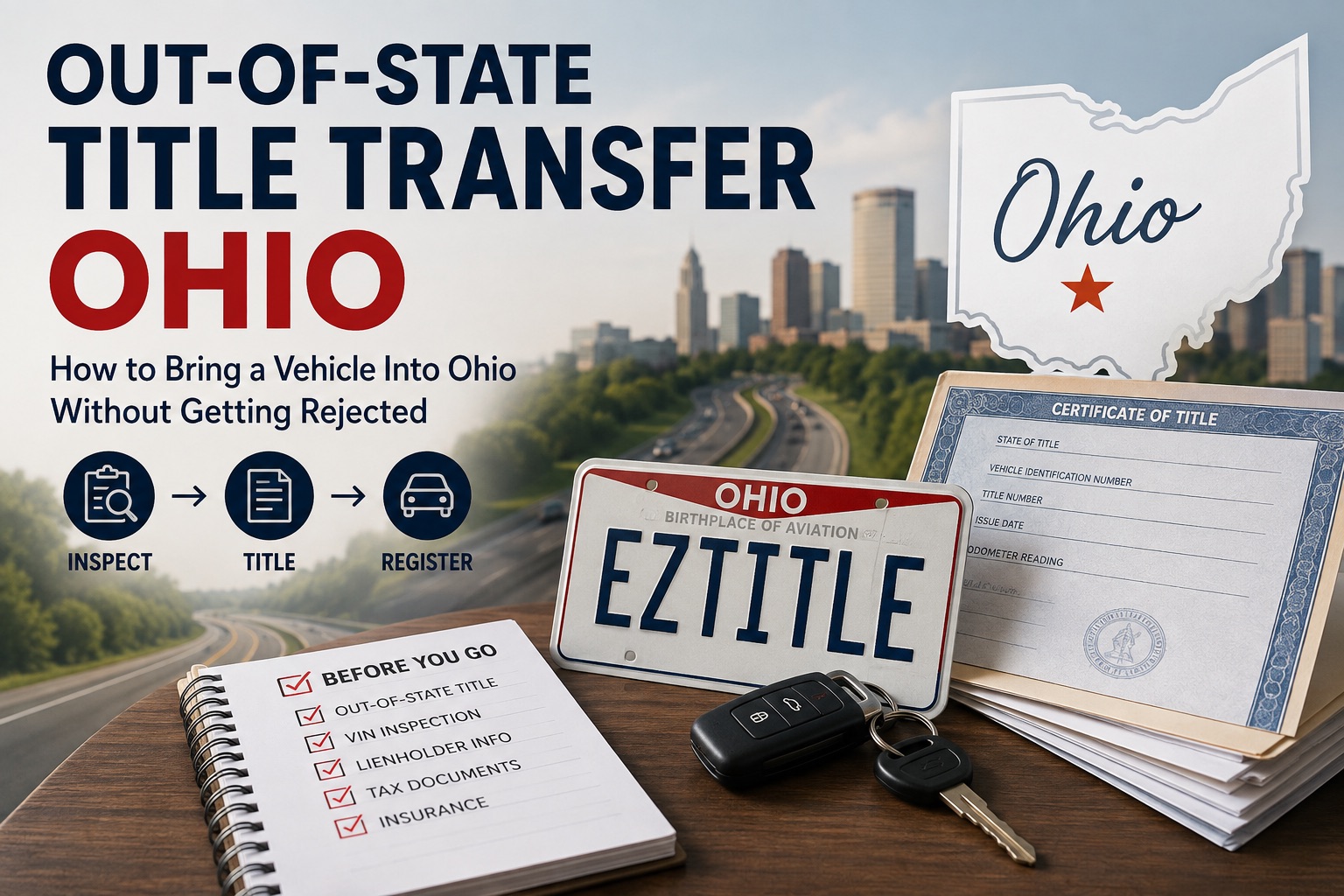
The basic Ohio process is actually simple for Out-of-State Title Transfer Ohio:
Inspect → Title → Register
What creates the wasted trips is everything around those three steps…the lender, the condition of the title, electronic records, co-owners, tax documentation, and differences between local offices.
That gives you an important first decision:
If the original title is in your name, you have it, there is no lien, and the ownership information is clean, you probably have a process problem.
If any of those things are not true, you may have a document problem that needs to be resolved before the normal process can work.
If you already know your situation is more complicated, EZ Ohio Title provides Ohio title transfer assistance for consumers who want help determining what needs to happen next.
Out-of-State Title Transfer Ohio: The Short Answer
For a vehicle previously titled in another state, the standard Ohio process is:
- Have the vehicle inspected for an out-of-state title transfer.
- Take the required ownership documents to a County Clerk of Courts title office and obtain the Ohio title.
- After the Ohio title is issued, register the vehicle and obtain plates through a Deputy Registrar.
One distinction prevents a surprising amount of confusion:
The Ohio BMV does not issue vehicle titles. County Clerk of Courts title offices do.
The BMV’s new-resident vehicle guidance lays out that order: title the vehicle first, then complete Ohio registration.
If you are moving to Ohio with a vehicle you already own, Ohio generally gives you 30 days after establishing Ohio residency to complete the title and registration process.
But before you start driving between offices, check the title itself.
Before You Go: The Five-Point Title Check
Look at these five things first:
1. Do you physically have the original out-of-state title?
If a lender or electronic title system controls it, solve that issue first.
2. Is there an active lien?
A financed vehicle can require coordination with the out-of-state lienholder before Ohio receives the ownership record it needs.
3. Is your name already on the title?
Moving a vehicle you already own is different from trying to title a vehicle you just bought from someone in another state.
4. Are multiple owners listed?
Do not assume one person can complete the transaction alone. Confirm the requirements before the appointment.
5. Has anything been signed incorrectly, crossed out, altered, or left incomplete?
Stop before making another change. A document problem can require a different remedy than an ordinary transfer.
If all five answers are clean, the standard process becomes much easier.
Out-of-State Title Transfer Ohio Step 1: Get the Vehicle Inspection
A vehicle last titled in another state generally needs an Ohio out-of-state vehicle inspection before the new Ohio title can be issued.
This is not a safety inspection.
Under Ohio Revised Code Section 4505.061, the inspection is used to verify identifying information about the vehicle, including items such as the VIN, make, model, body type, and mileage.
The vehicle must be present for the inspection.
Where Can You Get an Out-of-State Inspection in Ohio?
Qualifying inspections can be performed through:
- Deputy Registrar locations
- Licensed Ohio motor vehicle dealers
- Certain Clerk of Courts title locations that offer the service
The last point is where people lose time.
Do not assume every Clerk of Courts branch performs out-of-state inspections.
Availability can differ by county and even by branch. Some locations require an appointment or concentrate inspections at one office.
Confirm the inspection location before you go.
How Much Does the Ohio Out-of-State Inspection Cost?
Ohio currently sets the out-of-state inspection service fee at $8. A separate $1.50 Clerk of Courts processing fee applies to the inspection certificate.
Those are statewide components of the process. Other title, registration, tax, or local charges may apply separately.
Out-of-State Title Transfer Ohio Step 2: Get the Ohio Title
After the inspection, the title transaction belongs at a County Clerk of Courts title office.
For a straightforward transfer, expect to need items such as:
- Original out-of-state certificate of title
- Acceptable identification
- Completed Ohio title application
- Out-of-state inspection documentation
- Social Security information for the titled parties
- Applicable title fees
- Tax documentation when applicable
A photocopy of the title generally does not replace the transferable original ownership document.
Additional documentation may be required if the vehicle is financed, leased, jointly owned, newly purchased, inherited, or otherwise outside the clean-title scenario.
And this is the point where the condition of the title matters more than the checklist.
The Biggest Out-of-State Title Delay: Your Lender Still Has the Title
A financed vehicle changes the process.
Suppose you move from Florida to Ohio. Your name is on the vehicle, but the loan is still open and the lender controls the Florida title.
You can complete an inspection.
You can gather identification.
You can know exactly which Ohio office you need.
But Ohio still cannot issue the new title until the required ownership record becomes available.
The lender now controls part of your timeline.
What to Do First When a Lienholder Has the Out-of-State Title
Do this early:
- Contact the Ohio Clerk of Courts title office you plan to use.
- Tell them the vehicle is financed and the out-of-state lienholder controls the title.
- Ask for that office’s current out-of-state lienholder title-transfer instructions or request form.
- Confirm exactly where and how the lender should send or release the title information.
- Send the request to your lender as soon as possible.
- Keep a record of the request and follow up with the lender.
Some counties publish specific procedures for this situation because it happens regularly.
What the Clerk cannot do is control another financial institution’s internal processing.
That is why waiting until the end of your 30-day new-resident window to discover that your bank still holds the title is avoidable trouble.
If there is a lien, start with the title…not with the trip to the title office.
If your loan has already been paid but the lien remains unresolved, move into the more specific guidance for a lien still showing after payoff in Ohio rather than treating it as a normal interstate transfer.
If the loan is paid but the title itself never arrived, see what to do when you paid off a car but have no title.
Out-of-State Title Transfer Ohio Step 3: Register the Vehicle
Once the Ohio title exists, registration and plates are handled through a Deputy Registrar.
This is why “going to the BMV” is only part of the answer.
The offices have different jobs:
Vehicle inspection: Deputy Registrar, qualifying dealer, or participating title office
Ohio title: County Clerk of Courts title office
Registration and plates: Deputy Registrar
A qualifying buyer may be able to obtain a temporary tag before the permanent title process is complete. That does not replace the requirement to obtain the Ohio title before permanent Ohio registration.
Moving to Ohio With a Vehicle You Already Own
This is usually the cleanest out-of-state transfer.
Your name is already on the title. You have the original title. There is no lien or paperwork problem.
Ohio generally requires a new resident to title and register the vehicle within 30 days of establishing Ohio residency.
The state identifies events such as accepting employment, signing a lease, purchasing a home, or enrolling children in an Ohio school as examples connected with establishing residency.
In a clean case, there is not much reason to make this harder than it is.
Get the inspection. Take the correct documents to the title office. Then register the vehicle.
The problems begin when one of those clean-title assumptions is false.
Do You Owe Ohio Tax on a Vehicle You Already Owned?
Simply owning the car before you moved to Ohio does not automatically make the transfer tax-exempt.
Documentation and timing matter.
The Ohio Department of Taxation provides a new-resident use-tax exemption when qualifying conditions are satisfied.
A person who purchased and used the vehicle outside Ohio and establishes Ohio residency at least six months after the purchase date may qualify for the exemption if the required proof is provided.
If you bought the vehicle less than six months before becoming an Ohio resident, that specific exemption does not apply simply because the title was already in your name.
Ohio use tax may be due.
When qualifying sales or use tax was legally paid to another state, Ohio generally allows credit for that tax when appropriate documentation is provided.
These are different concepts:
Exemption: qualifying Ohio tax does not apply under the applicable exemption.
Credit: tax paid elsewhere may reduce the Ohio tax otherwise due.
If tax treatment is material to your transaction, bring the supporting documentation and confirm how the rule applies before completing the title transfer.
What If Your Out-of-State Title Is Electronic?
This is one area where a generic statewide checklist can become misleading.
Some states use electronic title or Electronic Lien and Title systems, particularly for financed vehicles. You may therefore arrive in Ohio without a physical certificate in your possession.
Ohio still needs an acceptable transferable ownership record before it can issue the Ohio title.
There is not one published Ohio procedure that cleanly describes the intake process for every electronic-title system used by every other state.
So do not guess.
Before your appointment, contact the title office with three pieces of information:
- The state that currently holds or issued the title record
- Whether an active lien exists
- The name of the lender or other party controlling the record
Ask what that office will require before Ohio can issue the title.
If a lender is involved, ask the lender how it handles an interstate retitling request.
For a deeper explanation of Ohio’s own electronic-title environment, see the Ohio electronic title transfer guide.
What If More Than One Owner Is Listed?
Do not assume that because your name appears first, you can complete the transfer alone.
Out-of-state titles can contain different ownership language and requirements. The treatment of multiple owners can depend on the actual title and the jurisdiction that issued it.
Before the appointment, identify:
- Every person named on the title
- How the ownership is expressed on the document
- Whether every owner can participate
- Whether an absent owner may need to provide a notarized power of attorney
Then call the title office with those details.
That is much more useful than arriving with one signature and hoping it is enough.
What If You Bought the Vehicle From Another State?
Buying a vehicle out of state introduces a second issue:
Ohio does not only need to retitle the vehicle. It also needs a valid transfer of ownership from the seller to you.
For a private-party purchase, review the title before making corrections. A seller signature in the wrong place, an unresolved lien, a missing owner, or an incomplete assignment can move the transaction out of the normal out-of-state process.
If the assignment itself is the problem, go directly to the guidance on a signed-over title mistake in Ohio rather than trying to repair the document yourself.
If the seller never gave you a usable title, start with bought a car without a title in Ohio.
If the ownership chain itself is wrong, see what to do when the car title is not in your name.
Those are document problems, not ordinary out-of-state transfer problems.
What About an Out-of-State Dealer?
Dealer paperwork varies by dealer and state.
Keep the complete purchase file, including title or Manufacturer’s Statement of Origin when applicable, purchase records, odometer paperwork, financing documents, lien information, and proof of any tax collected.
If tax was legally paid to another state, that documentation may be necessary to establish any Ohio credit that applies.
What Does an Out-of-State Title Transfer Ohio Cost?
Current Ohio guidance identifies several separate charges rather than one universal “transfer price.”
The current statewide base certificate-of-title fee is $18. A local permissive title fee can increase that amount to as much as $23 in participating jurisdictions.
The out-of-state vehicle inspection carries an $8 service fee, plus the $1.50 Clerk of Courts processing fee for the inspection certificate.
Your total can also include:
- Registration and plate fees
- Sales or use tax
- Lien-related fees
- Other transaction-specific charges
- Applicable local fees
Because some components vary, confirm the current fee schedule with the Clerk of Courts office handling your transaction before relying on an online total.
The Real Reason Out-of-State Transfers Get Rejected or Delayed
Most failures fall into one of two categories.
The Process Is Wrong
You went to the wrong office.
You skipped the inspection.
You assumed the branch you chose performs inspections.
You tried to register the vehicle before completing the title process.
These are usually easy to correct once you know the proper order.
The Document Is Not Ready
The lender still controls the title.
The title is electronic and the transferable record has not been arranged.
A co-owner is missing.
The seller made an assignment error.
The original title is missing.
A lien remains unresolved.
The tax documentation needed for an exemption or credit is not available.
These problems do not disappear because you reached the right counter.
That is the real dividing line in an out-of-state title transfer: process problem or document problem.
Figure out which one you have before you start making trips.
When It Makes Sense to Get Help
If the original out-of-state title is in your name, you possess it, there is no lien, and the paperwork is clean, you may only need to follow the standard Ohio process.
When the ownership record is not ready to transfer, the next step becomes less obvious.
EZ Ohio Title is a private Ohio title-services company. It is not the Ohio BMV, a County Clerk of Courts office, or another government agency.
If a lender controls the title, an electronic record is involved, the assignment is defective, ownership is unclear, or you simply cannot determine which process applies, contact EZ Ohio Title before changing the paperwork or making another trip.
The first job is not filling out another form.
It is identifying what is actually blocking the title.
Frequently Asked Questions
How do I transfer an out-of-state title to Ohio?
The standard process is to complete the required out-of-state vehicle inspection, obtain an Ohio title through a County Clerk of Courts title office, and then register the vehicle and obtain plates through a Deputy Registrar. Lien, ownership, or document issues may need to be resolved before the title step can be completed.
Does the Ohio BMV handle out-of-state title transfers?
The Ohio BMV does not issue vehicle titles. County Clerk of Courts title offices issue Ohio titles. Deputy Registrars handle registration and plates after the Ohio title has been issued.
How long do I have to transfer my title after moving to Ohio?
A new resident generally has 30 days after establishing Ohio residency to transfer the vehicle title and registration.
Do I need an inspection for an out-of-state title transfer in Ohio?
A vehicle last titled in another state generally requires an Ohio out-of-state vehicle inspection before the Ohio title is issued. The inspection verifies identifying information such as the VIN, make, model, body type, and mileage. It is not a vehicle safety inspection.
How much does an Ohio out-of-state vehicle inspection cost?
Ohio currently sets the out-of-state inspection service fee at $8. A separate $1.50 Clerk of Courts processing fee applies to the inspection certificate.
Who issues the Ohio title?
A County Clerk of Courts title office issues the Ohio certificate of title. The BMV and Deputy Registrar system handles registration and license plates, not issuance of the title itself.
What if my out-of-state lender has my title?
Contact the Ohio title office you intend to use and request its current out-of-state lienholder transfer instructions. The lender may need to release, transmit, or mail the required title record before Ohio can issue the new title, so this coordination should begin early.
Will I owe Ohio tax on a vehicle I owned before moving here?
Not automatically either way. A qualifying new resident who purchased and used the vehicle outside Ohio and established Ohio residency at least six months after the purchase may qualify for a use-tax exemption when the required proof is provided. Otherwise Ohio tax may apply, with credit potentially available for qualifying tax legally paid to another state.
What if my out-of-state title is electronic?
Contact the Ohio title office with the issuing state, whether there is an active lien, and who controls the electronic record. Incoming electronic-title procedures can depend on the originating state and lienholder, so confirm what transferable documentation the Ohio office requires before your appointment.